How is parking affected?
The shared street option has a modest parking impact on both stages. In Clifton Hill (Stage 4, Alexandra Parade to Queens Parade), 83 of 96 bays remain, with both accessible bays retained. In Collingwood (Stage 3, Johnston Street to Alexandra Parade), 71 of 81 bays remain.
Stay in the loop as the project moves forward. Council voted on 12 May. The next decisions are what officers design, what the consultation on traffic control measures delivers, and which items are deemed feasible. We'll update you when your voice will count.
We also post updates on Instagram at @nicerwellingtonstreet.
Clifton Hill (Stage 4)
Council voted on 12 May 2026. The shared street option was not adopted. This page sets out the case we made for it, which still bears on the changes and the community consultation on traffic control measures the adopted motion includes. See what was adopted and what comes next.
Council’s proposals for the Clifton Hill section (Alexandra Parade to Queens Parade) offer two options:
| Option 1: Shared Street | Option 2: Protected Lanes | |
|---|---|---|
| Current parking | 96 bays | 96 bays |
| Bays removed | 13 (no accessible bays removed) | 66 (including 2 accessible) |
| Bays remaining | 83 | 30 |
The shared street option removes 13 spaces on Wellington Street. Nine of those 13 are in the northern sub-section between Hodgkinson Street and Queens Parade, where Queens Parade has abundant on-street parking immediately around the corner.
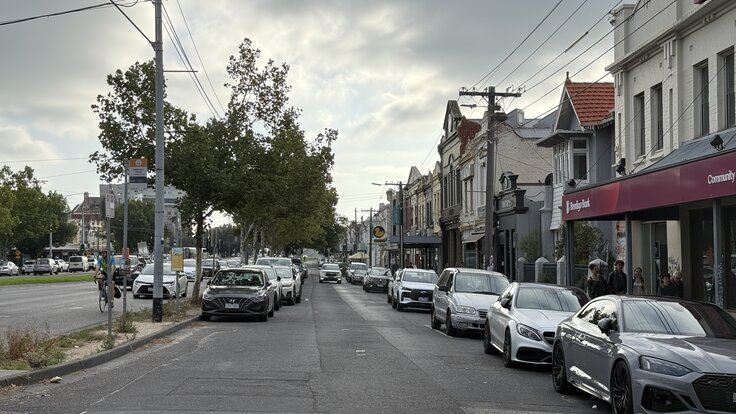
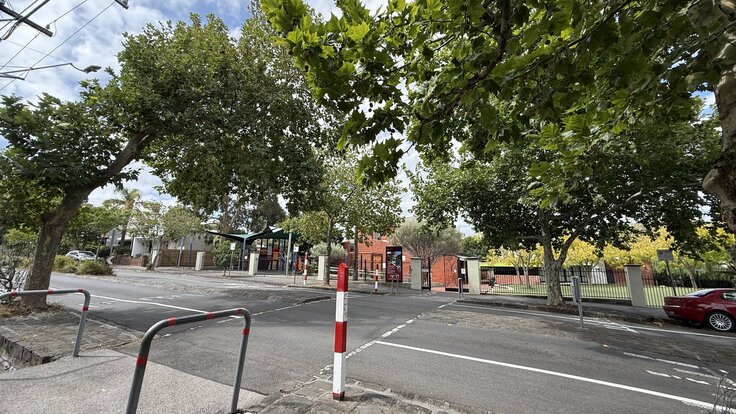
Three bays near the school are removed to create new pedestrian crossings: 1 beside Page Street and 2 at Council Street. The final bay is near Alexandra Parade, where the bicycle street section begins. Parking in the southern sub-section near the school is not removed to make space for cycling; it is removed to make space for pedestrians.
Around three spaces on Council Street itself (out of approximately 95, counted via Google Maps) are also removed where it meets Wellington Street to allow for the introduction of a median strip. These are not included in the 13 of 96 figure provided by the council because they are not on Wellington Street, but they are worth noting as an additional impact in the immediate area near the school.
The 66-space figure is accurate for Option 2 only. Option 2 removes 66, including the two accessible bays. Unlike the shared street option, those losses are not concentrated in one sub-section: they are distributed across the full length of the strip from Alexandra Parade to Queens Parade and they represent the majority of the parking on the whole section.
Wellington Street carries heavy non-local traffic and at busy times that traffic backs up along the street. A free bay is not much use if the street itself is gridlocked. Once non-local traffic is removed, the congestion goes with it.
Accessible parking
The two accessible bays on Wellington Street North are retained under the shared street option. They are removed under Option 2.
Local access on all streets is unchanged, so those who need to drive for accessibility reasons are unaffected.
Collingwood (Stage 3)
The Collingwood section runs from Johnston Street to Alexandra Parade.
| Option 1: Shared Street | Option 2: Protected Lanes | |
|---|---|---|
| Current parking | 81 bays | 81 bays |
| Bays removed | 10 | 12 |
| Bays remaining | 71 | 69 |
| Trees | 15 added (34 total) | 7 removed (12 total) |
The more striking difference between options is the tree canopy. Option 1 retains all existing trees and adds 15 new ones, bringing the total to 34. Option 2 results in a net loss of 7, leaving 12 trees on a street that currently has 19. On parking, the difference between options is modest: Option 1 removes 10 of 81 bays, Option 2 removes 121.
Concerns about local businesses
Nearby businesses more often benefit than suffer from parking reduction: people on foot and bike tend to visit more frequently than those arriving by car2.
-
YourSay Yarra, Wellington Street South (Collingwood). ↩
-
Volker, J.M.B. & Handy, S. (2021). Economic impacts on local businesses of investments in bicycle and pedestrian infrastructure: a review of the evidence. Transport Reviews, 41(4), 401–431. tandfonline.com. ↩