We also post updates on Instagram at @nicerwellingtonstreet.
Council voted on Tuesday 12 May. The shared street option was not adopted. See what was adopted and how it differs from what was on the table.
This site sets out the case for the shared street option: what it would have done for Wellington Street and why we supported it. That case still matters for the design phase and the community consultation on traffic control measures (such as turn restrictions during peak hours) that the adopted motion includes.
- Reduce non-local traffic
- Safer, greener street
- More liveable neighbourhood
What makes it possible
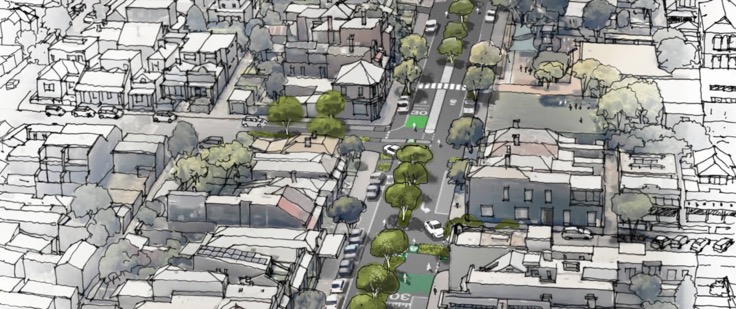
The key change is removing non-local traffic from our neighbourhood. Partial barriers and a reduced speed limit discourage vehicles from using Wellington Street as a shortcut between Alexandra Parade and Queens Parade. With those trips filtered out, what remains is the traffic that actually belongs here: residents, school families, deliveries, visitors, the church community.
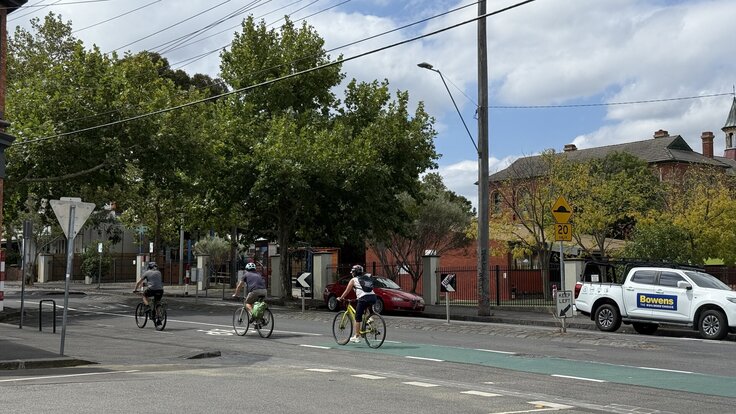
The speed limit drops to 30 km/h past the school, between Alexandra Parade and Hodgkinson Street, with a raised zebra crossing at the school gate that enforces the slower pace and pedestrian priority at all times. Eleven more trees go in on the Clifton Hill section, giving more shade and making the street a more pleasant place to walk.
In Clifton Hill, the stretch from Hodgkinson Street to Queens Parade gets physically separated cycling lanes. Around the school, people on bikes and vehicles share the street at a reduced speed of 30 km/h. Wellington Street is already one of the most-used cycling routes in the inner north and these changes complete the corridor.
The Collingwood section (Stage 3, Johnston Street to Alexandra Parade) gets the same shared street treatment under Option 1, with a 30 km/h speed limit and a modal filter at the Johnston Street end removing shortcut traffic. The shared street option adds 15 new trees to the 19 already there; Option 2 would result in a net loss of 7.
Council calls this Option 1, we call it the shared street. The options page sets out what each option involves and how they differ, but we think the shared street option provides the most benefit to our community.
What stays the same
Local access is fully retained on both stages. The barriers discourage non-local traffic, but don’t prevent local access, so anyone with a destination on Wellington Street can still drive there. Under the shared street option, most parking bays are retained. In Clifton Hill, 83 of 96 bays remain with both accessible bays kept; in Collingwood, 71 of 81 remain.
(You may have heard a figure of 66 spaces. That is the figure for Option 2 on the Clifton Hill section only. The parking page explains this in full.)
Why it works
Streets like this have been built in Yarra and elsewhere, with consistent results.
Yarra’s own 30 km/h trial on local streets produced a 51% fall in all crashes and a 70% fall in serious crashes.
When streets are filtered to remove non-local traffic, those trips don’t simply shift to the next street over. Studies consistently find a net area-wide reduction, with many trips disappearing entirely as people find another route or decide the detour is not worth making.
Napier Street in Fitzroy has operated as a shared street since 2019. Page Street, which runs through Clifton Hill Primary’s school grounds, has had a traffic barrier (a modal filter) since the 1970s, installed after local residents petitioned the then-Collingwood Council about dangerous conditions at the intersection with Gold Street.