On Tuesday 12 May 2026, Yarra Council adopted an amended version of the officer recommendation on Wellington Street. The shared street option was not adopted.
In brief
A mostly-improved version of the officer recommendation was eventually passed. Cr Wade’s two Collingwood additions (raised pedestrian crossings on Wellington Street and a median upgrade to match the Clifton Hill standard) were accepted into Cr Gomez’s amendment. A further Wade amendment, to implement additional traffic calming on side streets, was narrowly rejected: Crs Gomez, McKenzie, Ho and Harrison against, Crs Wade, Crossland, Aston and Jolly for.
The adopted motion does not address the through-traffic volumes on Wellington Street, and the officer recommendation that it built on explicitly ruled out anything that would. It does open the door to a further community consultation on traffic control measures, such as turn restrictions during peak hours into Wellington Street from Alexandra Parade and Queens Parade.
Crs Wade and Crossland voted against the final motion. Both supported stronger measures; their vote was against council not going further rather than against the items in the package.
What was adopted
Subject to the $200,000 design allocation in the draft 2026/27 budget, Council has directed officers to investigate and produce designs for the following works on Wellington Street and nearby local streets, for future delivery consideration. The resolution is a design and feasibility package, not a commitment to build: any actual construction depends on grants and future budget decisions, with detailed cost estimates and State Government approvals required where relevant.
The adopted works package, with items added or changed by Cr Gomez’s amendment and Cr Wade’s further amendment marked accordingly:
- Both sections, as a priority: re-line mark the existing bike lanes, repaint the green paint, re-line mark the road surface, and give consideration to re-sheeting the road surface. (Officer item; the “as a priority” framing, the road surface re-line marking, and the re-sheeting consideration added by Cr Gomez.)
- Clifton Hill: lighting upgrades on Hodgkinson Street; further upgrades to the existing school crossing on Wellington Street; new continuous footpath treatments on Council Street and Noone Street.
- Clifton Hill: a 30 km/h speed limit across all local streets bounded by Alexandra Parade, Smith Street (inclusive), Queens Parade and Hoddle Street.
- Collingwood: pedestrian safety upgrades at the Hotham/Gold, Keele/Gold and Sackville/Gold intersections; upgrade the existing Hotham Street and Easey Street continuous footpaths.
- Collingwood: three additional raised pedestrian crossings on Wellington Street at Mater Street, Hotham Street and Easey Street. (Added by Cr Wade.)
- Collingwood: upgrade the median to reflect the North Section, with more trees, planting and kerbs. (Added by Cr Wade.)
- Both sections: narrow the centre islands to widen the bike lane at the Wellington Street and Alexandra Parade intersection, on both the north and south sides. (Cr Gomez’s replacement for an officer item that also proposed removing two southbound parking spaces; the parking-removal element was dropped.)
- Both sections: improve visibility for vehicles pulling out from side streets, per the Road Safety Audit, by managing vegetation. (Officer item; the original also included removing some parking near intersections, which Cr Gomez dropped.)
- Both sections: bicycle early-start signals at the Wellington Street and Alexandra Parade intersections, to let cyclists enter the intersection and establish position before vehicles. (Added by Cr Gomez.)
- Clifton Hill: a new wombat crossing immediately south of the Hodgkinson Street roundabout, to help pedestrians and visitors to the Croatian Church of St Nicola Tavelic cross safely (subject to State Government approval). (Added by Cr Gomez.)
- Both sections: community consultation on traffic control measures, such as turn restrictions during peak hours. (Added by Cr Gomez.)
- Clifton Hill: after securing State Government approval, reinstate the left-hand turn for southbound vehicles at the Wellington Street and Alexandra Parade intersection, with a head start for pedestrians and cyclists across that intersection. (Added by Cr Gomez.)
The motion also:
- Recognises that the above works do not prohibit a street transformation option being progressed in the future.
- Acknowledges that further design funding may be required in the 2027/28 budget.
- Directs officers to seek external grant funding, with Council to consider funding some or all works from its budget if grants do not materialise.
- Commits any future engagement on delivery to Council’s Community Engagement Policy.
- Requires an update to Council in Q3 of the 2026/27 financial year.
- Thanks the community for the engagement and feedback provided through the process.
The full text of the adopted motion will appear in Yarra’s minutes for the 12 May meeting; a link will be added here once the minutes are published.
How it differs from the officer recommendation
The adopted package is a modified version of the officer recommendation (Option 3.1). The core of 3.1 carries through unchanged: the 30 km/h precinct in Clifton Hill, the lighting upgrades, the footpath treatments, the routine line-marking and the framing as a design and feasibility package rather than a commitment to build.
Cr Gomez’s amendment then changed the package in the ways set out below. Cr Wade’s further amendment added two Collingwood items on top, covered in their own section after Gomez’s changes.
Two safety items that traded parking for safety were rewritten to keep the parking
The officer recommendation included two items where a parking removal was part of the safety treatment. Both were edited.
- At the entry to Wellington Street across Alexandra Parade in the Collingwood section, officers proposed removing two southbound parking spaces and narrowing the centre island, to widen the bike lane at one of the most dangerous points on the corridor. The amendment removed the parking removal. A replacement item narrows the centre islands at the same intersection on both the north and south sides, which is a useful generalisation, but the south-side bike-lane widening is more modest than what officers proposed because the parking stays.
- For side-street visibility per the Road Safety Audit, officers proposed managing vegetation and removing some parking near intersections. The amendment kept the vegetation management and removed the parking removal. The road safety auditors were explicit that parking near intersections was part of the visibility problem they had identified, so this treatment now addresses part of what the auditors flagged rather than all of it.
Four new items were added
- Bicycle early-start signals at both ends of the corridor. At the Wellington Street and Alexandra Parade intersections in both Clifton Hill and Collingwood, cyclists get a separate green phase before vehicles. Left-turning vehicles across cyclists are the dominant crash mechanism on the corridor. A head start at signals is a well-established way of reducing that conflict.
- A wombat crossing south of the Hodgkinson Street roundabout. Doorknocking consistently surfaced the lack of a safe crossing here: parents, walkers, people heading to Queens Parade shops, and visitors to the Croatian church. The crossing is subject to State Government approval.
- Community consultation on traffic control measures, such as turn restrictions during peak hours. This is the only item with a plausible path to actually reducing the volume of cars cutting through Wellington Street. Turn restrictions are one example the motion names, but the consultation is on traffic control measures more broadly. Restrictions at the Alexandra Parade end help both sections; restrictions at the Queens Parade end help Clifton Hill and reduce the flow that then continues south through Collingwood. What this item delivers depends on what officers bring back and how the consultation is run. We will be pushing for it to produce meaningful traffic control measures.
- Reinstating the southbound left turn from Wellington Street onto Alexandra Parade, with a pedestrian and cyclist head start. The turn is currently banned; vehicles either detour or break the rules. Under the amendment it is reinstated, subject to State Government approval, with a head start for people walking and on bikes. The head start is a genuine safety treatment for the left-turn-across-cyclist crash type, additive to the early-start signals rather than redundant with them. The movement reinstatement itself works against reducing through-traffic: it makes Wellington Street a more convenient route for vehicles heading east on Alexandra Parade.
Cr Wade added two Collingwood items
Cr Wade’s further amendment added two items that apply only to the Collingwood section, both improving the South Section without trading anything away.
- Raised pedestrian crossings on Wellington Street at Mater, Hotham and Easey Streets. Raised crossings physically slow vehicles at each side-street intersection, in a way a posted speed limit alone does not. Council’s own baseline data shows measured speeds exceeding the posted limit at multiple Wellington Street sites; the Road Safety Audit flagged that gap as a concern. The crossings also make it easier and safer for people to cross Wellington Street on foot, which the bare officer recommendation did not address in Collingwood. They are pedestrian crossings rather than cycling treatment, so they do not address the dooring risk the auditors rated highest-severity, and design will need to ensure the ramps do not punish cyclists on a strategic cycling corridor.
- Upgrade the Collingwood median to reflect the existing North Section, with more trees, planting and kerbs. The Clifton Hill section already has a kerbed, planted median; Collingwood has a painted median and fewer trees. This closes that gap. A kerbed and planted median is harder to overtake across, harder to drift into, and visually narrows the carriageway, all of which act as passive constraints on driver behaviour. The additional trees also reduce the heat and amenity gap between the two sections.
Taken together with the rest of the package, Wade’s crossings give the corridor a more consistent set of slow points: the existing school crossing in Clifton Hill (to be upgraded further), the new wombat crossing south of Hodgkinson Street, and three additional raised crossings along the Collingwood section. Each one imposes a speed penalty on drivers using the corridor end-to-end, making Wellington Street less attractive as a shortcut in practice even though no item in the package directly targets traffic volumes.
How the amendments came together on the night
90 people were registered to speak to the item; 70 actually spoke, 36 in favour of change and 34 against. The amendments and final vote run from roughly the 2:51:50 mark of the meeting recording.
Cr Gomez moved his amendment first, seconded by Cr McKenzie: officer recommendation 3.1 as the base, two safety items rewritten to keep the parking (and reduce the safety), and four new items added (early-start signals, the wombat crossing, community consultation on traffic control measures, and the reinstated southbound left turn at Alexandra Parade).
Before that was put to a vote, Cr Wade moved a further amendment adding three additional raised crossings in Collingwood and the Collingwood median upgrade. Cr Jolly seconded; Cr Gomez accepted both additions.
Cr Wade then moved a second further amendment: that Council also implement the findings of the Stantec traffic-calming reports for both sections’ side streets (agenda pp.180-204). This package included the partial modal filter at the Gold/Sackville Street roundabout that the consultants said “significantly reduces the appeal of Gold Street as a north-south through route.”1 Cr Crossland seconded; Cr Gomez did not accept it. The amendment was put to a vote and lost 4-5: Wade, Crossland, Aston and Jolly in favour; Gomez, Davies, Ho, McKenzie and Harrison against. The side-street mitigations the agenda had identified to manage any diverted traffic, including the only measure that would have actively discouraged through-routing via Gold Street, are not part of the design package.
The Wade-amended Gomez motion was then debated and put. Some councillors repeated claims the agenda itself had already addressed: Cr Aston endorsed the side-street flooding concern the agenda’s own modelling does not support; Cr Jolly framed the project as one for cyclists rather than for residents and walkers. The amended motion passed 7-2, with Cr Wade and Cr Crossland opposing.
Their no votes are consistent with the argument they made through the amendment process: the package did not go far enough on through-traffic and the side-street mitigations the agenda had identified should have been included.
Our take
The adopted package does contain real safety and amenity improvements. The early-start signals at Alexandra Parade, the upgraded school crossing outside CHPS, the wombat crossing near Hodgkinson Street, three additional raised crossings in Collingwood, the Collingwood median upgrade and greening, and the 30 km/h precinct in Clifton Hill are all improvements on the status quo - if they go ahead. Council has only committed to investigating them and we may need to push to ensure that they happen.
What the package does not deliver is any change to through-traffic volumes on Wellington Street. The officer report explicitly ruled out anything that would directly reduce it. Wellington Street remains a non-local through-route, with safety improvements layered on around it. The two officer items that did trade parking for safety were rewritten by Cr Gomez to keep the parking.
The one item that might actually help address through-traffic is the community consultation on traffic control measures, such as turn restrictions during peak hours. We will be pushing for it to deliver measures at both the Alexandra Parade and Queens Parade intersections with Wellington Street that could meaningfully reduce through-traffic without modal filters and with minimal impact to locals.
We also post updates on Instagram at @nicerwellingtonstreet.
The consultation on traffic control measures is the next real opportunity. It is the one item in the adopted package that could meaningfully reduce through-traffic on Wellington Street, and what it delivers depends on what officers bring back and how many locals show up.
The motion also explicitly recognises that the adopted works do not prohibit a street transformation option being progressed in the future, and we expect a return to the same kinds of proposals as were originally put forward here if other measures do not suffice.
Register to stay informed and we'll let you know when the consultation opens and how to make your voice count. Until then, there's no need to act.
Background: the officer recommendation and where it fell short
The adopted package is the officer recommendation (Pillar 3.1) with Cr Gomez’s and Cr Wade’s amendments layered on top. The criticism we made of the officer recommendation still applies to what was adopted, because the core of the officer recommendation carried through unchanged. The sections below set out what officers were recommending and where it fell short. The amendments improved the package at the margins, particularly in Collingwood, but did not change the underlying trade-off: officers had ruled out anything that would reduce through-traffic volumes. The adopted motion does not change that.
What council staff recommended
Officers recommended a do-minimum package on Wellington Street and its surrounding streets:
- A 30 km/h speed limit across the area bounded by Alexandra Parade, Smith Street, Queens Parade and Hoddle Street.
- Repainting the existing painted bike lanes (no change to their layout). The bike-lane line marking and green paint were refreshed earlier in 2026; this is routine maintenance.2
- Lighting upgrades on Hodgkinson Street near the church and the roundabout.
- In Clifton Hill (the North Section): new continuous footpath treatments on Council Street and Noone Street.
- In Collingwood (the South Section): upgrades to the existing continuous footpaths on Hotham Street and Easey Street, defined in the agenda as smoothing the bluestone on the roadway and re-line-marking.3
- Raised pedestrian crossings at three Gold Street intersections (Hotham, Keele, Sackville). These were originally proposed by Stantec as part of the mitigation package for any traffic displaced from Wellington Street if traffic barriers were installed there. They were included in the officer recommendation while the change options that created the displacement were ruled out.4
- Sightline and vegetation work near intersections, including some car park removals.
- A small widening of the bike lane at the south side of the Wellington and Alexandra Parade intersection.
What it did not include: any traffic calming on Wellington Street itself in Collingwood, any reduction in the volume of cars cutting through, or physically separated bike lanes. A full-time zebra crossing at Clifton Hill Primary was mentioned as one possible upgrade among several but was not committed to. Cr Wade’s further amendment added raised crossings on Wellington Street at three Collingwood intersections; the substantive criticism below otherwise applies to what was adopted.
The recommendation was to investigate and design these works, not to commit to building them. The $200,000 in next year’s draft budget is for design and feasibility. Whether anything is actually built depends on grants; staff themselves rated the strongest grant pathway (state cycling-corridor funding) as unlikely.5
Why it fell short
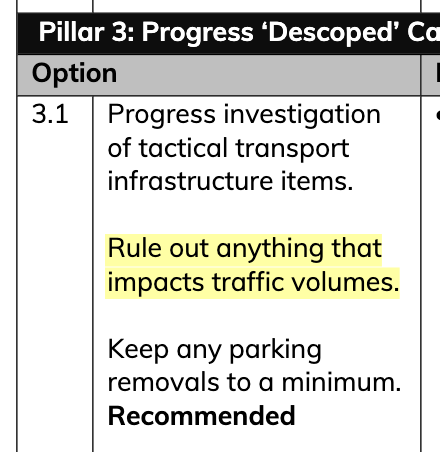
It doesn’t address the main problem. Wellington Street is heavily used as a non-local through-route. In Collingwood, council’s own monitoring found that up to 88% of southbound morning traffic at Alexandra Parade had no local origin or destination.6 The officer recommendation explicitly “rule[s] out anything that impacts traffic volumes,” in the staff report’s own words.7 The recommended package leaves that volume in place and adds maintenance and lighting around it. The amendments adopted on the night do not change that.
The road safety auditors’ highest-severity recommendations are not fully delivered. Council’s road safety audit made eleven findings. Two were rated highest-severity for fatal and serious injury and carried “Primary” recommendations (defined by the auditors as those that “practically eliminate” the risk). One covers the dooring risk along the entire length of Wellington Street, where the auditors recommend kerb-protected bike lanes between kerb and parking; the adopted package does not deliver this. The other is the Hodgkinson Street roundabout, where the auditors recommend speed cushions on approach to bring speeds down to the Safe System tolerance of 30 km/h; the 30 km/h speed limit moves in the right direction but a posted limit on its own typically does not bring 85th-percentile speeds to the posted level (council’s own baseline data records 85th-percentile speeds above the posted limit at multiple Wellington Street sites). The Primary mechanism the auditors specified, physical speed cushions, is not delivered.8
The consultation report shows majority support for change, but officers recommended something more limited. Across all respondents in council’s own consultation, 64% support a change option in Clifton Hill and 62% in Collingwood.9 On the locals-only cut officers cited as their basis for declining the change options, support for change was the majority in both sections once the revised data analysis (corrected by officers after the agenda was published) was used. What was recommended, and what was adopted, is neither of the two change options that were consulted on. Detail in the section on local support below.
The opposition’s concerns were refuted on the agenda’s own evidence
Two claims drove most of the opposition: that the proposal would close Wellington Street, and that it would flood local side streets with traffic. The staff report contradicted both and also set out additional mitigations if any side-street impact did occur.
“11,000 cars will be displaced.” The 11,000 figure on the local signs was roughly double the actual two-way traffic on the Clifton Hill section of Wellington Street, which is about 5,600 vehicles a day in council’s own measurements.10 Wellington Street in Collingwood carries higher volumes still, as it also carries traffic between the Eastern Freeway and the CBD.
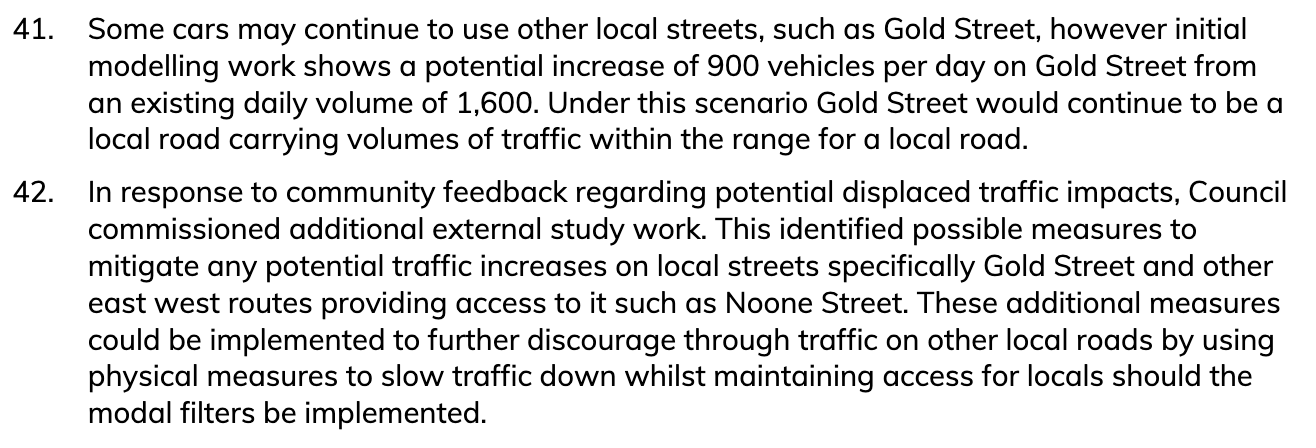
“Side streets will be flooded.” Staff wrote directly that “the results of preliminary traffic modelling do not support these concerns and officers have identified additional measures to manage any traffic diversion that does occur.”11 Council’s modelling for Gold Street in Collingwood (the worst-case street in the analysis) showed a potential increase of 900 vehicles per day from a base of 1,600, which staff described as keeping Gold Street “within the range for a local road.”12 Staff also noted the modelling was “likely being an overestimation of traffic impacts,” and that “the modelling work does not show that large volumes of traffic will use other local roads nearby.”13

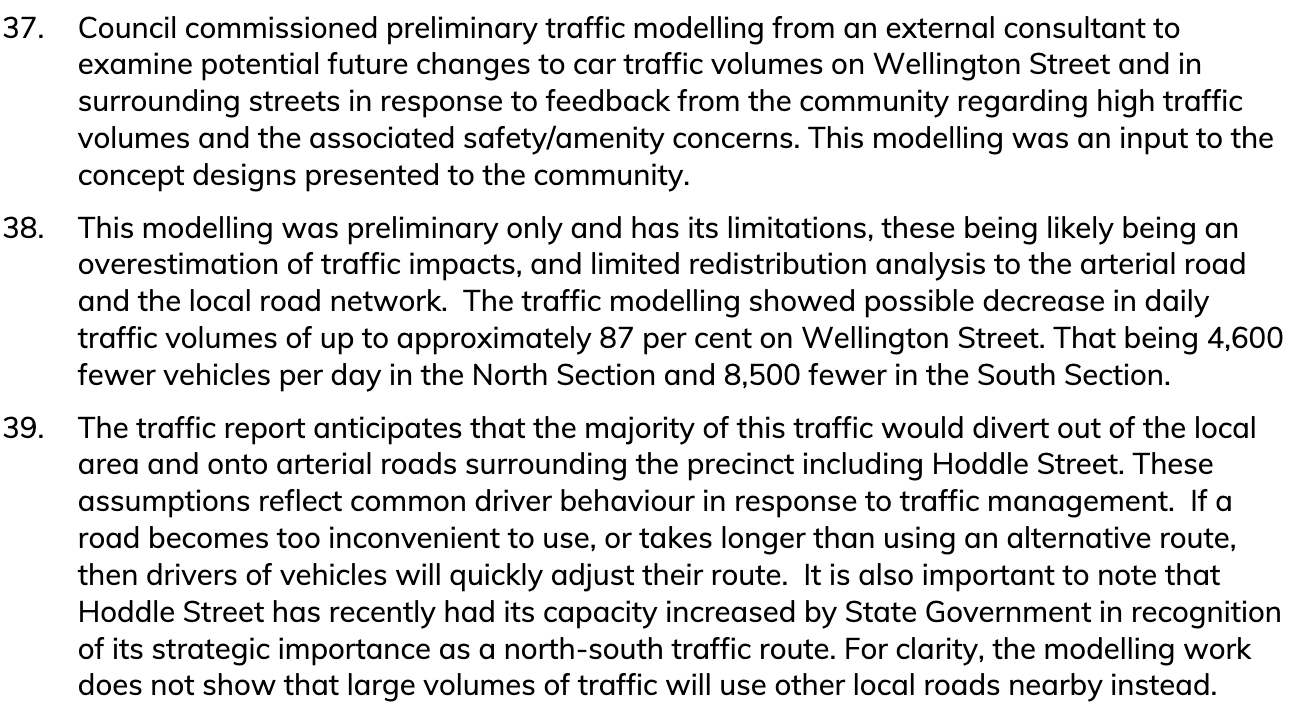
Mitigations were available if any side-street increase occurred. In response to community feedback, council commissioned an additional external study identifying mitigation measures for Gold Street and the east-west streets that connect to it, such as Noone Street.14 These included physical traffic-calming measures and a partial traffic barrier at the Gold and Sackville Streets roundabout, which the consultants said “significantly reduces the appeal of Gold Street as a north-south through route.”1 These measures were not on the table during the consultation that closed in October 2025; they appeared in the agenda for the first time. The lost Stantec amendment on the night would have added them to the design package; they are not currently part of what was adopted.
For fuller detail on side-street traffic, see the Traffic page.
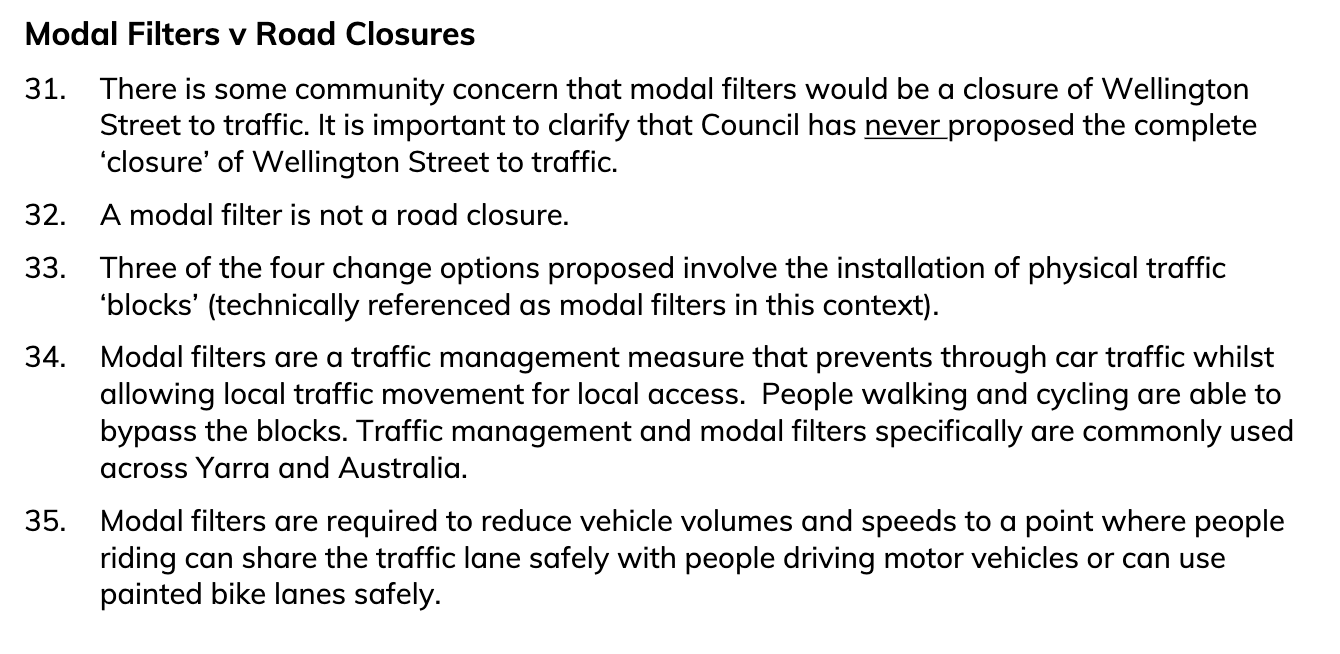
“Road closure.” Staff were explicit that the proposed traffic barriers would not be a road closure: “It is important to clarify that Council has never proposed the complete ‘closure’ of Wellington Street to traffic. A modal filter is not a road closure. Modal filters are a traffic management measure that prevents through car traffic whilst allowing local traffic movement for local access. People walking and cycling are able to bypass the blocks. Traffic management and modal filters specifically are commonly used across Yarra and Australia.”15 The change options would have stopped cars cutting through without blocking local access. There are at least 40 such barriers already in place across Yarra, including Page Street next to Clifton Hill Primary.
Local support for change was already there
The consultation showed majority support for change over doing nothing, even while the concerns about closures and side-street flooding remained uncorrected. Headline support across all respondents was 64% in Clifton Hill and 62% in Collingwood. On the locals-only cut staff used as the basis for declining the change options, the result was a majority in favour of change in both sections: 54% in Clifton Hill (up from 53% as originally published in the agenda) and 51% in Collingwood (up from 50%).9
The original Table 2 figures in the agenda understated support for change. Officers issued a corrected version after the agenda was published. The revised figures, used above and shown below, lift the locals-only support-for-change share in both sections.
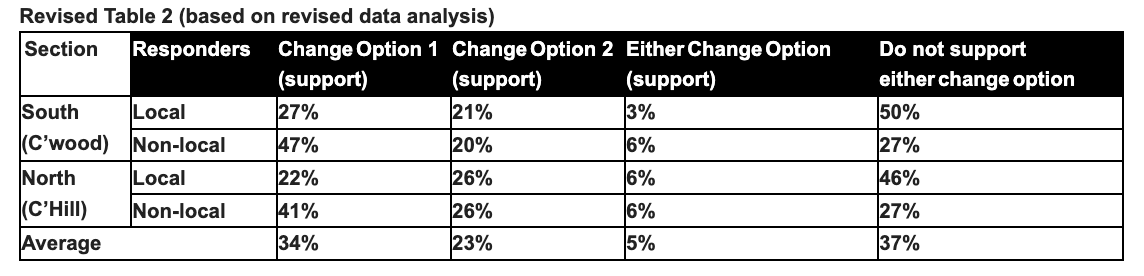
Doorknocking in the streets most affected by the proposal found support higher than the consultation figures suggested, once residents had a chance to talk through what was and was not being proposed. The agenda corrected the headline misunderstandings on closures and side-street traffic on the public record.
Further reading
The full agenda for the 12 May meeting is published on Yarra City Council’s site. Three places to look:
- The formal recommendation begins at agenda page 8.
- The narrative report describing the recommendation runs from page 8 to around page 24.
- The detailed analysis of all the options council considered is in Attachment 7.1.13, starting at page 1054.
Council’s full set of supporting reports (traffic modelling, road safety audit, traffic calming options, the consultation report) is on the Data page.
-
Stantec, Wellington Street Traffic Calming Options Report and Supplement (Attachment 7.1.7). The supplement describes a partial traffic barrier at the Gold/Sackville Street roundabout: “Partial modal filter roundabout design significantly reduces the appeal of Gold Street as a north-south through route. Through traffic would need to perform a u-turn on Sackville Street to continue [north/south].” (agenda p.203). The supplement was published on 5 May 2026 and was not visible to the public during the consultation that closed in October 2025. ↩ ↩2
-
The bike-lane line marking and green paint on Wellington Street were refreshed earlier in 2026; what’s recommended is a further repaint, comparable in scope to routine line-marking maintenance carried out across Yarra’s road network. ↩
-
Attachment 7.1.13 (Options Further Information), agenda p.1055, items (g) and (h). Direct text: “South Section: Upgrade the Hotham Street continuous footpath by smoothing the bluestone on the roadway, and re-line marking” and “South Section: Upgrade the Easey Street continuous footpath by smoothing the bluestone on the roadway, and re-line marking.” The North Section items (Council Street and Noone Street) are described separately as “new continuous footpath treatments” with associated engineering and drainage considerations. ↩
-
Attachment 7.1.13 (Options Further Information), agenda p.1055, item (e): “North Section: Raised pedestrian crossings on side streets. Gold Street/Hotham Street, Gold Street/Keele Street and Gold Street/Sackville Street.” These three intersections are the focus of Stantec’s traffic-calming recommendations in the Wellington Street Traffic Calming Options Report (Attachment 7.1.7), where they are presented as part of a package designed to manage traffic displaced from Wellington Street if traffic barriers were installed. The recommendation includes the crossings while ruling out the change to Wellington Street that creates the displacement they were meant to manage. ↩
-
Same source, agenda p.1056. Direct quote: “It does not directly respond to some of the key findings of the Road Safety Audit on what is defined by State as a strategic cycling route. On this basis, it is unlikely to receive funding from the State Government as an upgrade to a cycling route.” ↩
-
Officer report (Attachment 7.1), agenda p.15. “the data collected showed that during the AM peak, up to 88% of vehicles that entered Wellington Street at Alexandra Parade and travelled south did not have an origin or destination within the local area.” ↩
-
Officer report (Attachment 7.1), agenda p.21, Pillar 3 / Option 3.1 row of the recommendations table. Direct text under “Brief Description”: “Progress investigation of tactical transport infrastructure items. Rule out anything that impacts traffic volumes. Keep any parking removals to a minimum. Recommended.” ↩
-
Road Safety Audit Existing Conditions (Attachment 7.1.8), agenda pp.227-228. The two findings rated HIGH for fatal and serious injury, both carrying Primary recommendations: Finding 5 (dooring risk along the audit length), recommending kerb-protected lanes between kerb and parking; Finding 6 (Hodgkinson Street roundabout), recommending “installing LATM treatments – such as a speed cushions – on approach to the roundabout to further lower vehicle speeds.” The auditors describe the underlying problem as “Given the shape of the roundabout, it is expected that crashes would occur at speeds greater than the Safe System tolerance for this crash type (30km/h)” (agenda p.228). The recommendation introduces a 30 km/h speed limit across the area, which addresses the speed-tolerance question in principle, but a posted speed limit on its own typically does not bring measured speeds to the posted level. Council’s own baseline data (Attachment 7.1.4) shows the 85th-percentile speed currently exceeds the posted limit at multiple Wellington Street monitoring sites, including in the existing 30 km/h section in Collingwood. The Primary mechanism the auditors specified (physical speed cushions on approach to the roundabout) is not in the adopted package. ↩
-
Two sources. All-respondents support for change (62% Collingwood, 64% Clifton Hill): Capire Consulting Group, Building a Safer Wellington Street: Stage 3 and Stage 4 Engagement Report (Attachment 7.1.9), Figure 12 at agenda p.253 (South Section, all respondents) and Figure 16 at agenda p.274 (North Section, all respondents). The figures combine the share preferring Option 1, the share preferring Option 2 and the share preferring either change option: 1,042 of 1,686 respondents in the South (62%) and 1,070 of 1,684 in the North (64%). Locals-only is a majority in favour of change in both sections (51% South, 54% North): revised officer report Table 2, circulated by City of Yarra Governance and Integrity to registered speakers ahead of the 12 May meeting, superseding the version printed in the agenda at p.18. Revised local respondents in the South Section (Collingwood): 27% Option 1, 21% Option 2, 3% either, 50% neither (i.e. 51% support some change, 50% do not; figures sum to 101% due to rounding). Revised local respondents in the North Section (Clifton Hill): 22% Option 1, 26% Option 2, 6% either, 46% neither (i.e. 54% support some change, 46% do not). The original Table 2 figures in the agenda (South locals 25/22/3/50 and North locals 20/27/6/47, yielding 50/50 and 53/47 respectively) understated support for change in both sections; the revised figures are used above. Note that Table 2’s locals row is structurally a count of connection-claims rather than unique respondents and the percentages should be treated with caution; the all-respondents figures from Capire Figures 12 and 16 are not affected by that issue. ↩ ↩2
-
Council baseline traffic data (Attachment 7.1.6, GHD traffic analysis report, Table 2, agenda p.126). Wellington Street between Queens Parade and Alexandra Parade carries approximately 5,600 vehicles per day in total (3,000 northbound, 2,600 southbound). The Stage 3 (Collingwood) figure is closer to 10,000. ↩
-
Officer report, agenda p.18, para 65. Direct quote: “The results of preliminary traffic modelling do not support these concerns and officers have identified additional measures to manage any traffic diversion that does occur.” Para 64 (preceding) sets out the concern: “A key concern raised is that modal filters on Wellington Street will re-route large amounts of traffic to other local streets particularly Gold Street.” ↩
-
Officer report, agenda p.15, para 41. Direct quote: “Some cars may continue to use other local streets, such as Gold Street, however initial modelling work shows a potential increase of 900 vehicles per day on Gold Street from an existing daily volume of 1,600. Under this scenario Gold Street would continue to be a local road carrying volumes of traffic within the range for a local road.” ↩
-
Officer report, agenda p.15, paras 37-39. Direct quotes: “This modelling was preliminary only and has its limitations, these being likely being an overestimation of traffic impacts, and limited redistribution analysis to the arterial road and the local road network.” And: “For clarity, the modelling work does not show that large volumes of traffic will use other local roads nearby instead.” Para 38 also notes the modelling showed a possible decrease in daily traffic volumes of up to approximately 87% on Wellington Street: 4,600 fewer vehicles per day in the North Section and 8,500 fewer in the South Section. ↩
-
Officer report, agenda p.15, para 42. Direct quote: “In response to community feedback regarding potential displaced traffic impacts, Council commissioned additional external study work. This identified possible measures to mitigate any potential traffic increases on local streets specifically Gold Street and other east west routes providing access to it such as Noone Street. These additional measures could be implemented to further discourage through traffic on other local roads by using physical measures to slow traffic down whilst maintaining access for locals should the modal filters be implemented.” ↩
-
Officer report, agenda p.14, paras 31-34. The longer quote in the body combines paras 31, 32 and 34. ↩